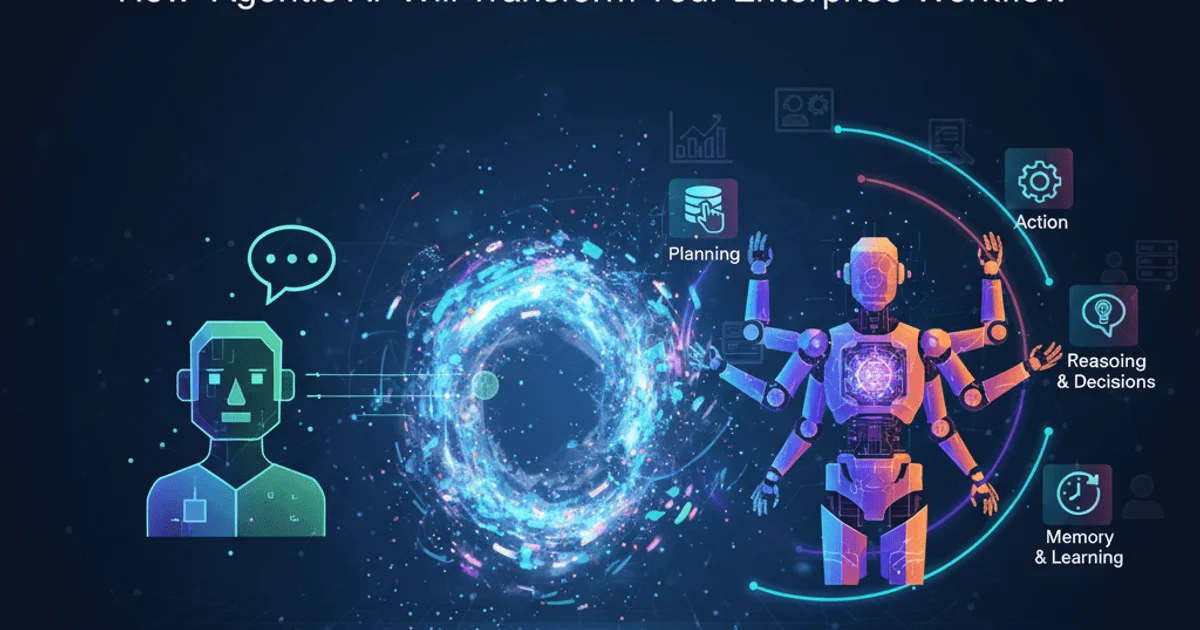
From Chatbots to Agents: How Agentic AI Will Transform Your Enterprise Workflow
Generative AI has given us incredibly powerful assistants. Drafting emails, summarizing documents, answering questions -- the capabilities are undeniable. But for all their intelligence, these tools remain fundamentally passive. They wait for a prompt, respond, and then forget until the next instruction. They are brilliant, but they are not problem-solvers. They are assistants, not workers.
This is where agentic AI changes the game. It is the leap from an AI that answers your question to an AI that can execute a multi-step project. And the enterprise world is moving fast: a 2025 McKinsey global survey found that 62% of organizations are at least experimenting with AI agents, and 23% are already scaling agentic systems in production. Gartner projects that by 2026, 40% of enterprise applications will feature task-specific AI agents, up from less than 5% in 2025.
This isn't hype. The platforms, frameworks, and real-world deployments already exist. Understanding what's actually happening -- and what separates the successful deployments from the expensive failures -- is critical for any enterprise leader.
What Agentic AI Actually Means (Beyond the Buzzword)
Agentic AI refers to AI systems designed to autonomously plan, execute, and iterate on complex tasks without constant human intervention. Unlike a chatbot that responds to a single query and waits, an agent can break down a high-level goal into sub-tasks, use external tools (APIs, databases, browsers, code interpreters), make decisions when it encounters obstacles, and self-correct when something goes wrong.
The key capabilities that separate agents from chatbots:
- Planning: Interpret a goal and create a step-by-step execution plan, decomposing complex objectives into manageable sub-tasks
- Tool use: Interact with the real world through APIs, databases, file systems, web browsers -- not just generate text
- Reasoning: Process information, evaluate options, handle exceptions, and make decisions at branching points
- Memory and persistence: Maintain context across a long sequence of actions and learn from previous outcomes
- Self-correction: Detect when an approach isn't working and adjust strategy without human intervention
The distinction matters. A chatbot can tell you that your Salesforce pipeline looks weak in the Northeast. An agent can identify the weak pipeline, pull the relevant account data, draft re-engagement emails for the top 10 at-risk accounts, schedule them through your email platform, and create follow-up tasks in the CRM -- all from a single high-level instruction.
The Real-World Deployments That Prove the Model
Let's get specific about what's actually happening in production, because the gap between "agentic AI" as a concept and agentic AI as deployed enterprise software is narrowing faster than most leaders realize.
Salesforce Agentforce
Salesforce launched Agentforce in late 2024 and by mid-2025 had over 8,000 customers deployed, generating $900 million in AI and Data Cloud revenue within six months. These are not experimental pilots. Agentforce agents handle customer service interactions, qualify sales leads, and execute marketing workflows autonomously within the Salesforce ecosystem. The pricing model evolved quickly -- from $2 per conversation to a consumption-based $0.10 per action via Flex Credits -- reflecting how rapidly agent usage scaled beyond initial projections.
ServiceNow AI Agents
ServiceNow was ranked #1 for Building and Managing AI Agents in the 2025 Gartner Critical Capabilities report. Their AI Agent Orchestrator and AI Control Tower provide thousands of pre-built agents for IT service management, HR operations, and customer service. When an employee submits an IT ticket, the system doesn't just route it -- it diagnoses the issue, checks the knowledge base, attempts automated resolution, and only escalates to a human when it genuinely can't solve the problem.
Microsoft Copilot and Agent 365
Microsoft reported over 160,000 organizations deploying custom agents through Copilot Studio by late 2025. Their Agent 365 platform allows enterprises to deploy, organize, and govern agents across the entire Microsoft ecosystem -- integrating with Adobe, SAP, ServiceNow, and Workday. The play here is horizontal: agents that work across your existing Office 365, Azure, and Dynamics infrastructure rather than requiring a separate platform.
Klarna's Customer Service Transformation
Perhaps the most instructive enterprise case study is Klarna. Their AI assistant handled 2.3 million customer conversations in its first month alone -- two-thirds of all customer service volume -- doing the work equivalent of 700 full-time agents. Resolution time dropped from 11 minutes to under 2 minutes. Repeat inquiries fell 25%.
But here's the part most vendors won't tell you: by mid-2025, Klarna's CEO admitted that optimizing purely for cost had compromised quality, and the company began rehiring human agents for complex cases. The lesson isn't that AI agents don't work. It's that the most effective deployments are hybrid: agents handle the volume and speed, humans handle the judgment and nuance. Klarna now operates a model where AI manages roughly two-thirds of conversations with seamless handoffs to human agents when confidence is low. The company reports $60 million in savings while maintaining improved customer satisfaction.
The Frameworks Powering Enterprise Agents
Behind these platform deployments, a maturing ecosystem of frameworks makes it possible to build custom agentic systems. The landscape has consolidated significantly since the explosion of tools in 2023-2024:
LangGraph (from LangChain) handles complex stateful workflows with conditional logic, branching, and cycles. It's running in production at LinkedIn, Uber, and over 400 other companies. Think of it as the tool for building agents that need to make decisions at every step.
CrewAI focuses on role-based multi-agent collaboration -- you define agents with specific roles, goals, and backstories, then assign them tasks that they coordinate on. CrewAI raised $18 million and now powers agents at over 60% of Fortune 500 companies.
Microsoft Agent Framework emerged from the merger of AutoGen and Semantic Kernel, with general availability in early 2026. It supports C#, Python, and Java -- important for enterprises with polyglot codebases -- and integrates natively with Azure.
Amazon Bedrock Agents provides a managed service for building agents that can access company data through knowledge bases and take actions through API integrations, all within the AWS ecosystem.
The convergence point is clear: every major cloud and SaaS platform is building agent infrastructure. The question for enterprises is not whether to adopt agentic AI but how to integrate it into existing operations without creating chaos.
Where Agents Are Making Their First Real Impact
Based on actual deployments (not vendor promises), here's where agentic AI is delivering measurable results today:
IT Service Management
This is the most mature use case. Agents that can diagnose issues, query knowledge bases, execute remediation scripts, and escalate intelligently. ServiceNow's deployment data shows resolution rates above 80% for common IT tickets without human intervention.
Customer Service
Klarna, Salesforce Agentforce, and dozens of other implementations demonstrate that agents can handle high-volume, well-defined customer interactions -- password resets, order tracking, refund processing, FAQ resolution. Gartner predicts agentic AI will autonomously resolve 80% of common customer service issues by 2029. The key insight: this works when the problem space is bounded and the escalation path is clear.
Software Development
AI coding agents (GitHub Copilot, Cursor, Claude Code) have moved beyond autocomplete into genuine agentic territory -- understanding codebases, writing tests, debugging issues, and executing multi-file changes. Developer productivity gains of 25-55% are consistently reported across studies.
Sales and Revenue Operations
Lead qualification, pipeline analysis, automated outreach sequencing, and competitive intelligence gathering. Salesforce Agentforce's rapid adoption in this space validates the use case.
Finance and Accounting
Invoice processing, expense reconciliation, audit preparation, and compliance checking. These are high-volume, rule-heavy workflows where agents excel because the decision criteria are well-defined and the cost of human labor is high.
The Governance Question You Cannot Ignore
Here's the reality check: Deloitte's 2026 State of AI survey found that while 75% of companies plan to deploy agentic AI within two years, only 21% have a mature governance model for autonomous agents. That gap is where enterprise risk lives.
Deploying agentic AI is not a software deployment. It is a workforce integration. An agent that can access your CRM, trigger API calls, and modify records is, for all practical purposes, an employee with system access. And it needs the same governance infrastructure:
- Clear scope and boundaries: What can this agent do? What is it explicitly forbidden from doing?
- Identity and access management: What systems can it access, and with what permissions?
- Audit trails: Every action logged, every decision traceable
- Escalation protocols: When does the agent stop and hand off to a human?
- Performance metrics: How do you measure whether it's actually delivering value?
I'll dive deep into this governance framework in my next post. For now, the critical takeaway is this: the technology for building agents is increasingly mature. The organizational readiness to deploy them responsibly is not. The enterprises that invest as heavily in governance as they do in capabilities will be the ones that scale successfully.
The Shift That Matters
The move from chatbots to agents is not incremental. It represents a fundamental change in what AI can do inside an organization -- from answering questions to executing work. The platforms are live. The frameworks are production-ready. The early results are compelling.
But the hardest part is not the technology. It's the organizational design: defining what agents should do, setting boundaries they can't cross, building the feedback loops that make them better over time, and redesigning human roles to focus on the judgment, creativity, and relationship work that agents can't replicate. The companies getting this right are not the ones with the most sophisticated AI -- they're the ones with the most thoughtful integration strategy.
Related Posts
View all posts